


The Role of SOPs in Improving Operational Efficiency
14 Apr 2026Every business that operates at scale eventually confronts the same fundamental problem: how do you get dozens, hundreds, or thousands of people to do the same tasks the right way, every time? The answer is rarely found in hiring harder or managing more closely. It lives in the systems a company builds around its people. Standard Operating Procedures, or SOPs, are among the most effective of those systems, yet they are also among the most underutilized.
The role of SOPs in improving operational efficiency extends well beyond creating a paper trail. When designed and deployed correctly, SOPs act as a force multiplier. They compress training timelines, reduce costly errors, protect the business during audits, and create a culture where quality is the default rather than the exception. To measure this impact, companies track concrete indicators such as error rates, cycle times, task completion accuracy, and customer satisfaction scores. These metrics make it possible to tie SOP performance directly to business outcomes.
What Makes an SOP Actually Useful
An SOP is a written set of step-by-step instructions for completing a routine task in a consistent way. The definition is simple, but the difference between an SOP that works and one that collects dust comes down to execution.
Clarity, purpose, and accessibility
Useful SOPs share three qualities. First, they use language that is clear and direct, written for the person doing the work rather than for a compliance officer reviewing it later. Second, they explain not just the steps but the purpose behind each one. When a technician understands why a valve check matters, they treat it differently than when they view it as an arbitrary box to tick. Third, effective SOPs stay accessible. Procedures buried in binders or locked behind intranet folders never reach the people who need them at the point of work.
Choosing the right format
The format matters too. Checklists work well for repetitive multi-step tasks because they let workers track progress without holding everything in their head. Text-based step-by-step guides suit complex processes that require judgment at each stage. Video-based SOPs work particularly well for physical tasks that are difficult to describe in words. The right format depends on the task and the workforce.
How SOPs Drive Operational Efficiency

The role of SOPs in improving operational efficiency becomes clearest when you look at where inefficiency actually comes from. Most operational waste is not the product of lazy workers or poor management. It comes from variability: two people completing the same task in two different ways, one of which produces a rework, a delay, or a customer complaint.
Eliminating variability at the source
SOPs eliminate that variability at the source. When a process is documented and followed consistently, outcomes become predictable. Predictability reduces rework. Reduced rework frees capacity. Freed capacity either absorbs more volume or gets redirected toward higher-value activities. This chain reaction is why well-run operations consistently outperform those that rely on individual judgment and informal knowledge sharing.
Faster onboarding, faster productivity
Consider onboarding. Without SOPs, a new hire shadows a senior employee and absorbs whatever habits that person carries, good and bad. With SOPs, the new hire follows a documented process that reflects the best practices of the entire organization.
This reduces onboarding time and accelerates the point at which a new employee reaches full productivity.
Compounding gains across every function
Beyond onboarding, SOPs improve daily task execution across every function. They help dispatch teams handle service requests in the right sequence. They guide technicians through maintenance procedures with the correct safety checks built in. They ensure invoicing follows a consistent flow that reduces billing errors. Each of these improvements is small on its own, but together they compound into measurable gains in throughput, quality, and customer satisfaction.
SOPs and Employee Engagement
There is a common misconception that SOPs constrain employees or signal a lack of trust. In practice, the opposite is true. Clear procedures reduce one of the most significant sources of workplace stress: ambiguity about what good performance looks like.
Reducing ambiguity and building confidence
Well-designed SOPs contribute directly to a stronger employee experience by giving workers clear and consistent guidelines, which reduces confusion, minimizes errors, and fosters a sense of accountability and ownership. When employees know exactly what is expected and have the tools to meet that standard, they feel more competent and more confident in their roles.
Involving employees in the process
Employee engagement also improves when workers participate in the creation and refinement of SOPs. Involving employees in the SOP development process builds a sense of ownership that enhances buy-in and acceptance across the team. People are far more likely to follow a procedure they helped design than one handed down from above without context. This participatory approach also produces better SOPs, since the people closest to the work often identify inefficiencies and edge cases that managers miss from a distance.
The result is a virtuous cycle: engaged employees follow SOPs more consistently, consistent execution produces better outcomes, and better outcomes reinforce the value of having clear procedures in place.
Compliance, Safety, and Legal Protection

The role of SOPs in improving operational efficiency is also deeply connected to risk management. In industries such as healthcare, manufacturing, food service, and field maintenance, a missed step in a safety procedure can cause harm to employees, customers, and the company itself.
SOPs as a documented safeguard
SOPs act as a documented safeguard. They codify safety checks, define the correct handling of hazardous materials, specify equipment lockout procedures, and record what was done and when. This documentation serves two purposes. It guides the person doing the work in real time, and it creates an audit trail that satisfies regulators, insurers, and clients after the fact.
Audit readiness and legal exposure
Organizations without clear, current SOPs struggle during audits. They cannot prove that tasks were performed according to a defined standard, which creates legal and reputational exposure. Those with robust SOPs walk into audits prepared. The procedures are the evidence.
Scaling Operations Without Losing Quality
Growth amplifies whatever is already present in an operation. A business that delivers consistent quality through strong processes continues to deliver consistent quality as it grows. A business that relies on informal knowledge and individual habits sees those inconsistencies multiply with every new hire and every new location.
Carrying best practices into new territory
This is one of the most direct ways the role of SOPs in improving operational efficiency manifests in practice. When procedures are standardized and digital, an organization’s operational playbook travels with it, whether it is opening a new commercial property, adding a new vendor, or expanding to another region. New sites do not start from scratch. They inherit the accumulated best practices of the entire organization.
Protecting institutional knowledge
SOPs also preserve institutional knowledge. When a long-tenured technician, manager, or specialist leaves, they take years of tacit knowledge with them unless that knowledge has been captured in documented procedures. Businesses that build strong SOP cultures treat documentation as an ongoing responsibility rather than a one-time project. The result is operational resilience that does not depend on any single individual staying.
The Problem with Static SOPs
Many businesses have SOPs that exist on paper but fail to deliver results. The most common reason is that the procedures are treated as documents rather than as tools.
Outdated procedures erode trust
Static SOPs become outdated quickly. Regulations change. Equipment changes. Customer expectations change. A procedure written two years ago may no longer reflect how the task should be performed, but if no one reviews and updates it, workers either follow an outdated process or stop consulting the SOP altogether and revert to personal habit.
Accessibility and complexity as failure points
Accessibility is the second failure point. An SOP that a field technician cannot reach while standing in front of a piece of equipment is not a useful SOP. It is a record-keeping artifact. Modern digital platforms solve this by embedding SOPs directly into the workflow, surfacing the relevant procedure on the worker’s device at the exact moment it is needed.
The third failure point is complexity. SOPs written by subject matter experts sometimes reflect every nuance the expert holds in their head rather than the essential steps a practitioner needs to complete the task correctly. Long, dense SOPs get skimmed or skipped. The discipline required to write a genuinely useful SOP is the discipline to leave things out.
Digital SOPs and the Future of Operational Procedures
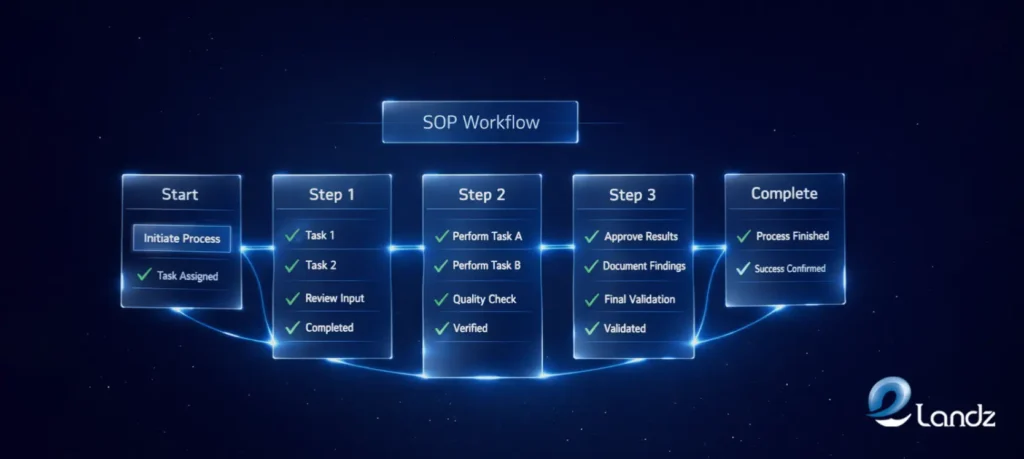
The evolution from paper-based manuals to digital SOPs represents more than a format change. Digital SOPs transform procedures from static documents into living tools that actively support and enhance operational performance, incorporating multimedia elements, interactive content, and real-time updates that make them more effective for frontline workers.
Automation and workflow integration
The next development is procedural automation. When an SOP step is completed within a digital platform, that completion can trigger the next action in the workflow automatically. A parts replacement logged by a technician can immediately update inventory and generate a purchase request. A completed inspection can auto-generate a customer report. These integrations eliminate the manual handoffs that slow operations down and introduce errors at the seams between tasks.
SOPs and continuous improvement
SOPs also integrate naturally with continuous improvement frameworks such as the Plan-Do-Check-Act cycle, where they document the execution phase and serve as the baseline against which process changes are measured over time. This connection between documented procedures and improvement methodology is what transforms SOPs from a compliance tool into a driver of ongoing performance gains.
Conclusion
The role of SOPs in improving operational efficiency is not a narrow compliance story. It is a story about what happens when an organization takes its best knowledge, captures it in a form that everyone can access and act on, and commits to keeping that knowledge current. The businesses that do this well spend less time correcting mistakes, onboard people faster, satisfy regulators more easily, and scale without sacrificing quality.
Those who treat procedures as administrative paperwork pay the cost of variability every single day.
SOPs do not limit people. They free people to focus on the parts of their work that require genuine judgment, creativity, and skill, confident that the routine parts are handled correctly every time.
Frequently Asked Questions
Got questions about SOPs and how they connect to efficiency? Here are straightforward answers to the ones that come up most often.
What is an SOP, and how does it support operational efficiency?
How do SOPs reduce errors in daily operations?
What is the biggest obstacle to effective SOP implementation?
How often should SOPs be reviewed and updated?
Can small businesses benefit from SOPs the same way large ones do?
Table Of Content