

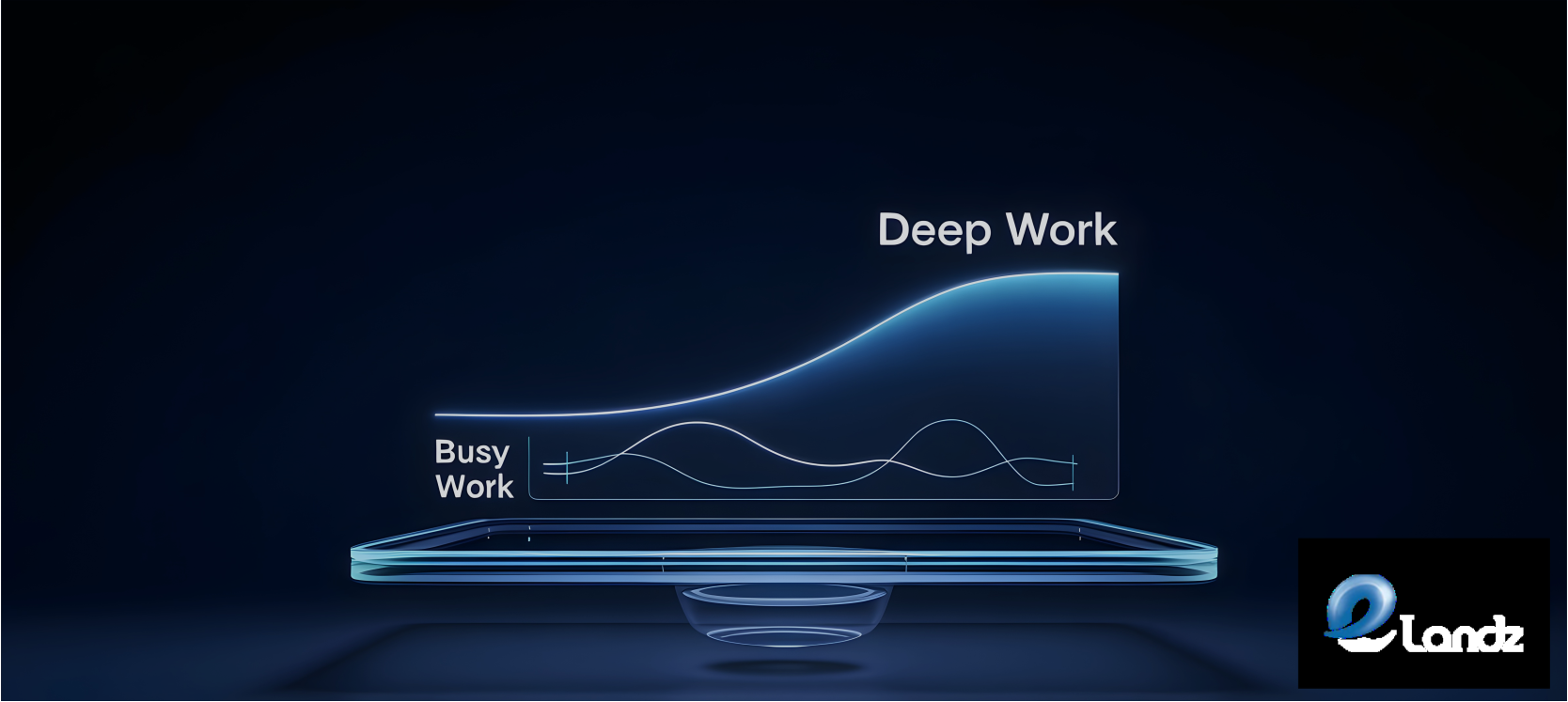
Deep Work Versus Busy Work: Why What You Do Matters More Than How Much You Do
08 Apr 2026Most professionals gauge their productivity by how packed their schedule looks. But if you want to measure operational efficiency, the ratio of meaningful output to time spent, a full calendar often tells the wrong story.
You can end a day exhausted, having answered fifty emails and attended three meetings, and still have moved nothing important forward. That gap between feeling productive and being productive is exactly where the distinction between deep work versus busy work lies.
What Is Busy Work?
Busy work keeps you occupied without building anything. It is the loop of checking messages, reorganising folders, responding to low-priority requests, and attending meetings that could have been an email. None of it is useless, since inboxes do need clearing, but it operates at a surface level. It demands your time without demanding your mind.
The Illusion of Progress
The problem with busy work is not just that it is low value. It creates the sensation of productivity. You stay active, the hours pass, and your brain registers effort. By the end of the day, you feel like you worked, because you did, just not on anything that compounds.
What the Research Shows
What looks like multitasking is almost always rapid task switching, where your brain oscillates between activities rather than holding any one thread deep. Research from Stanford found that people who frequently juggle multiple tasks are actually less productive and more distracted than those who focus on a single task at a time. A University of London study found that multitaskers showed IQ drops similar to those caused by sleep deprivation.
What Is Deep Work?
The term was popularised by Georgetown professor Cal Newport, who defines it as focused, uninterrupted cognitive effort on tasks that are both demanding and meaningful. Deep work is writing the strategy document, solving the technical problem, and building the creative framework. It is the output that requires full mental engagement over sustained time.
The Flow State Advantage
When you work deeply, your brain enters what psychologists call a flow state, a condition of high focus where speed and quality both increase. You produce better work in less time than you would bouncing between shallow tasks. Deep work vs busy work is not a question of effort.
You often exert more obvious effort during a shallow, reactive day. It is a question of cognitive depth and what that depth makes possible.
Why Deep Work Is Becoming Rare
Newport argues that deep work is becoming simultaneously rarer and more valuable. Technology has made distraction the path of least resistance, and most devices are designed to fragment attention. Most workplaces reward visible responsiveness over invisible thinking.
The person who replies to messages instantly looks engaged. The person who blocks three hours to write appears idle. Organisations built around that optics problem systematically underinvest in the work that actually drives results.
Why We Default to Busy Work
Busy work wins by default for several reasons.
It Carries No Risk
Clearing emails carries no risk of failure. Deep work requires you to sit with uncertainty while writing something original or solving a real problem. You might produce nothing good for a stretch. That possibility is uncomfortable, and shallow tasks offer a reliable escape from it.
It Looks Like Commitment
Being responsive signals availability to others. Being unreachable for three hours to do focused writing looks, from the outside, like you are doing nothing. This is a structural problem in most workplaces, not a personal failing.
It Has Become the Default
Years of constant connectivity have genuinely degraded the capacity for sustained focus. When you spend most of your time reacting to messages, notifications, and whatever lands in your feed, your brain loses the habit of holding a single thread. Deep thinking starts to feel uncomfortable simply because you have stopped practising it.
The Real Cost of Avoiding Deep Work
The long-term cost is not just slower output. The important projects never get the attention they require. Strategy gets written in stolen hours. Creative problems get solved partially, then set aside. The work that would actually differentiate your career keeps getting deferred to a future block of time that never fully arrives.
Every hour you spend in genuine focus produces results that shallow time simply cannot replicate. A skilled thinker working in deep work mode does not just produce more. They produce things of a different quality. Understanding deep work versus busy work makes that clearer. One produces momentum, the other produces motion. Both look like work, but only one moves you forward.
How to Shift from Shallow to Deep
Making the shift does not require a complete overhaul of your day. It requires a few deliberate decisions, repeated consistently until they become a habit.
Schedule It Rather Than Wait for It
The most important shift Newport recommends is scheduling your deep work rather than waiting to feel ready. Motivation follows action. Set a fixed block, eliminate distractions, and start anyway.
Protect Your Best Hours
Assign specific windows for cognitively demanding work and keep those windows free from email and meetings. Batch shallow tasks into separate, contained windows rather than letting them bleed through the entire day. The goal is not to eliminate reactive work but to give focused work protected time.
End the Day with Intention
A deliberate shutdown ritual signals to your brain that the work is done. The unconscious mind continues processing problems after you step away. Rest is not lost time. It is part of the thinking.
Build Tolerance for Boredom
If you reach for your phone every time you have a free moment, you train your brain to resist concentration. Letting yourself sit with unstructured time rebuilds the tolerance for sustained focus that deep work requires.
Conclusion
Deep work vs busy work is not just a productivity question. It is a question about where your best thinking actually goes. Start with one protected session each day, keep it short at first, and build from there. Work that demands full concentration is becoming rarer, which means those who practise it consistently hold a real and growing advantage.
Frequently Asked Questions
Here are quick answers to the most common questions about deep work versus busy work.
What is the main difference between deep work and busy work?
How long should a deep work session last?
Can everyone do deep work, or is it a special skill?
Why is deep work harder today than it used to be?
Do you have to eliminate all shallow work?
Table Of Content