


How Data Analytics Improves Efficiency and Performance
16 May 2026Every business owner wants to cut waste, serve customers better, and grow profits, but most struggle to measure where the real problems actually are. That is exactly where data analytics steps in. How data analytics can improve efficiency is one of the most searched questions among operations managers and business owners today, and the answer is more straightforward than most people expect.
Without data, you cannot tell which is which until something goes wrong. With the right analytics tools in place, you can see those warning signs early, fix problems before they cost you, and track every gain you make as you improve.
What Data Analytics Actually Means for Businesses
A plain-language look at the four types of analytics and how each one serves a different business need.
Data analytics is the process of collecting information from your operations, cleaning it up, and examining it to spot patterns. It is not just for large corporations with massive IT departments, because small and mid-sized businesses use it just as effectively today. Modern tools have made it possible for almost any team to pull insights from the numbers they already collect every day.
There are four main types that businesses use in practice.
- Descriptive analytics looks at what already happened, such as your sales last quarter or your top complaints last month.
- Diagnostic analytics digs into why it happened, for example, why sales dropped in March.
- Predictive analytics uses past patterns to forecast what will happen next/
- Prescriptive analytics goes a step further by suggesting what you should do about it.
Most businesses start with descriptive analytics because it requires the least technical setup. From there, the more advanced types become easier to adopt once your data habits are strong. Each level adds more value and more certainty to your decisions.
According to industry research published in 2025, business intelligence tools deliver an average return on investment of 127% within three years. That figure shows just how much businesses stand to gain by making analytics a core part of how they operate.
Better Decisions Without the Guesswork
How replacing gut feeling with real evidence leads to faster, safer, and more profitable choices every single day.
Removing Guesswork
When a manager chooses a supplier, sets a price, or adjusts staffing levels based on gut feeling alone, they are taking on unnecessary risk. Data gives those decisions a solid foundation that anyone on the team can understand and trust.
Running Scenario Simulations
You can compare outcomes, test different strategies virtually, and then choose the one most likely to succeed. This approach reduces costly trial and error and speeds up the path to results.
Providing Real-time Dashboards
Instead of waiting for a monthly report to learn that something went wrong, managers can see what is happening right now and course-correct on the spot.
A retail business, for example, can monitor slow-moving inventory in real time and run a targeted promotion before the stock becomes a write-off.
Cutting Costs Across Operations

Three specific areas where analytics consistently reduces spending and protect profit margins for businesses of all sizes.
Predictive Maintenance
Equipment failures are expensive, not just to fix but because of the downtime they cause. Predictive maintenance uses sensor data and historical patterns to spot when a machine is likely to fail before it actually does.
Maintenance teams can then schedule repairs at convenient times instead of scrambling during a breakdown. This single change can save manufacturers and logistics companies a significant amount each year.
Supply Chain and Inventory Control
Overstocking ties up cash while understocking loses sales, and analytics solves this tension by accurately forecasting how much inventory you actually need based on real demand signals.
Smart routing tools can find the most efficient delivery paths, cutting fuel costs and delivery times at the same time. Procurement teams can track supplier performance data and shift to better partners before a quality problem ever reaches customers.
Energy Use
Energy is a cost most businesses overlook until the bills arrive. Smart sensors connected to an analytics platform track real-time energy consumption across a facility and identify exactly where waste is happening.
Automated systems can then adjust heating, cooling, and lighting based on actual occupancy and usage patterns. The savings add up quickly, and the environmental benefit is a bonus that customers and investors increasingly notice.
Workforce Productivity and Staffing
How analytics helps managers put the right people in the right place at the right time, while also improving how staff feel about their roles.
- Smarter Scheduling
- Labour is usually the largest expense for service-based businesses, and poor scheduling is one of the biggest efficiency drains. Analytics platforms predict busy periods based on historical traffic, seasonal trends, and even weather patterns so managers can put the right number of staff on at exactly the right times. The result is fewer idle hours and fewer moments when customers have to wait too long.
- Identifying Real Performance Gaps
- Workforce analytics reveals training gaps and performance trends across teams. If a particular department is consistently slower than others, the data can show whether it is a skills issue, a process bottleneck, or a resource shortage. Addressing the actual cause rather than applying a generic solution saves time and money and keeps employees engaged.
- Improving Employee Retention
- When staff see that decisions about their roles are based on fair, transparent data rather than personal opinion, trust in leadership tends to grow. Higher engagement leads directly to lower turnover, which is a real and measurable cost saving in itself.
Understanding and Keeping Your Customers
The tools businesses use to predict what customers want next and take action before those customers have to ask.
Customer data shows you who is buying, when, how often, and what makes them stop. With predictive models, you can identify at-risk customers before they leave and offer them something relevant at just the right moment.
Personalization at scale becomes possible when analytics is running in the background. Instead of sending every customer the same message, you can tailor communication based on each person’s purchase history and preferences. This increases conversion rates, reduces churn, and builds the kind of loyalty that repeat revenue depends on.
Voice of the Customer data, including surveys, reviews, and support transcripts, adds another layer when combined with behavioural data.
Together, they give a full picture of what customers actually experience versus what they say they want.
Speeding Up Product and Service Development
Why data-driven product teams launch faster, waste less budget, and build things customers actually want to buy.
New products fail when they are built around assumptions rather than evidence. Analytics shortens the distance between an idea and a successful launch by providing real feedback from real users throughout the development process. Teams can test prototypes, measure responses, and refine designs before investing heavily in full production.
Data also helps businesses prioritize which features or improvements matter most to customers. Instead of building everything at once, teams focus on the changes that will have the largest measurable impact. This approach reduces development time and keeps products closely aligned with what the market actually wants.
Common Challenges to Expect
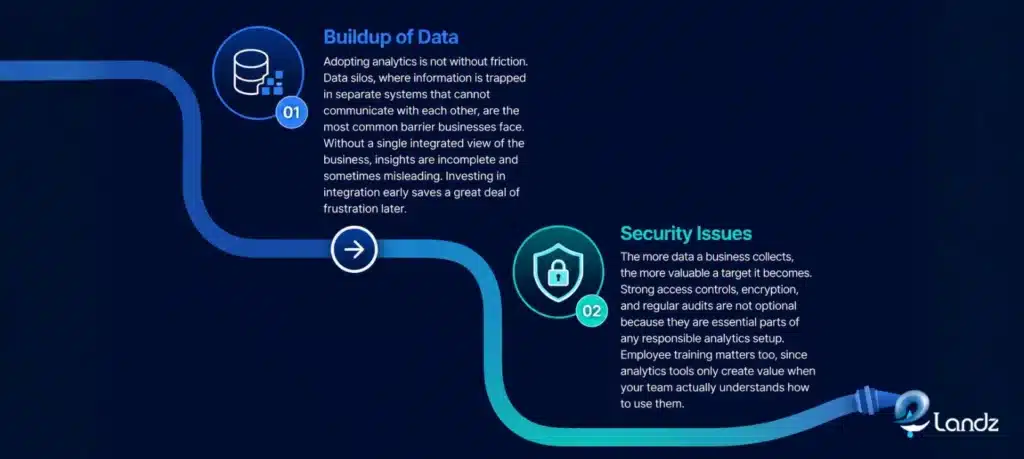
Knowing what typically goes wrong during an analytics rollout helps you avoid the mistakes that slow most businesses down.
Buildup of Data
Adopting analytics is not without friction. Data silos, where information is trapped in separate systems that cannot communicate with each other, are the most common barrier businesses face. Without a single integrated view of the business, insights are incomplete and sometimes misleading. Investing in integration early saves a great deal of frustration later.
Security Issues
The more data a business collects, the more valuable a target it becomes. Strong access controls, encryption, and regular audits are not optional because they are essential parts of any responsible analytics setup. Employee training matters too, since analytics tools only create value when your team actually understands how to use them.
How to Measure the Results
The numbers that tell you whether your analytics investment is actually working or just producing pretty reports nobody reads.
Any analytics effort needs a way to measure its own success. Useful metrics include cost savings from reduced waste or maintenance, faster cycle times in production or service delivery, higher customer satisfaction scores, and increased output per employee. Tracking these consistently lets you see what is working and what needs adjustment.
Return on investment from analytics tends to compound over time. Early wins build confidence, which leads to deeper adoption, which produces better data, which produces better insights. The businesses that treat analytics as a long-term discipline rather than a one-time project are the ones that pull consistently ahead of their competitors.
What Elandz Can Do for Your Business
The Elandz team handles the technical side so you can focus on running your business. Whether you need supply chain visibility, customer behaviour insights, or real-time operational reporting, Elandz builds solutions that fit your scale and budget without the enterprise price tag.
Conclusion
Knowing how data analytics can improve efficiency is not a complex theory. It is a practical shift in how decisions get made every day. When businesses replace gut feeling with reliable data, they waste less, serve customers better, and grow more consistently. The tools are accessible, the results are measurable, and the competitive advantage is real.
Start small if you need to. Pick one process, collect the data around it, and make a better decision. Build from there, because the businesses pulling ahead right now are not the ones with the biggest budgets. They are the ones who take their data seriously.
Frequently Asked Questions
These are the questions we hear most often from business owners who are just getting started with analytics or looking to get more from the tools they already have in place.
What is the main benefit of data analytics for small businesses?
How long does it take to see results from data analytics?
Do you need a large IT team to use data analytics tools?
What is the difference between descriptive and predictive analytics?
Is customer data safe when used for analytics?
Table Of Content