


Leading vs Lagging Indicators in Operational Performance
21 May 2026Every business owner wants to cut waste, serve customers better, and grow profits, but most struggle to measure where the real problems actually are. That is exactly where data analytics steps in. How data analytics can improve efficiency is one of the most searched questions among operations managers and business owners today, and the answer is more straightforward than most people expect.
Every business decision carries a measurable cost. Poor performance measurement alone drains an estimated 30% of annual revenue, according to IBM research. Knowing which numbers to watch, and when to watch them, is exactly where leading vs lagging indicators become the most important tools in any operations manager’s toolkit.
What Leading vs Lagging Indicators Actually Mean
Performance measurement only works when you understand what each metric is actually telling you. Leading vs lagging indicators represent two fundamentally different types of signals, and confusing one for the other leads to slow decisions and missed opportunities.
The Core Distinction
A leading indicator signals what is likely to happen before it happens, capturing activity or behavior that precedes an outcome. A lagging indicator measures what has already occurred, confirming results after the fact. Together, leading vs lagging indicators give operations teams both a forecast and a report card.
Why You Need Both
Operations teams that rely only on one type are working with half a picture. Leading metrics tell you where you are heading, while lagging metrics confirm whether you got there. The goal is a measurement system that does both at once.
Why Operational Teams Get This Wrong
Operations teams do not fail because they lack data. They fail because the data they trust most only describes the past, and by the time it arrives, the window to act has already closed.
The Rearview Mirror Problem
Most operations departments lean too heavily on lagging data, filling monthly reports with outcomes that are already locked in. A manufacturing team that tracks defect rates at the end of a production run discovers problems after thousands of units are already compromised. Relying only on outcomes is like driving while staring at the rearview mirror.
The Cost of Delayed Signals
A customer service team that reviews satisfaction scores at the end of the month learns about broken processes weeks after customers already experienced them. By that point, the damage is done and the opportunity to intervene has passed. Leading vs lagging indicators work best when operations leaders recognize this imbalance and correct it deliberately.
How Leading Indicators Work in Operations
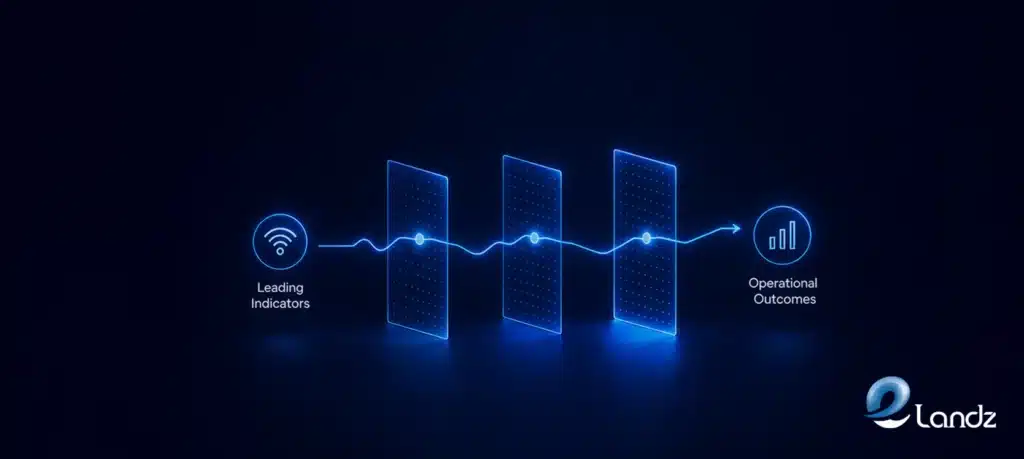
Leading indicators are only useful when they are chosen carefully and reviewed consistently. The difference between a genuine leading indicator and a misleading one comes down to whether there is a real causal link between the metric and the outcome it is supposed to predict.
What Makes a Leading Indicator Valid
A strong leading indicator changes before the outcome you care about changes, and it has a genuine causal connection to that outcome, not just a coincidental one. Operations managers who track supplier response time weekly, for example, can intervene before on-time delivery rates start falling. The value of any leading indicator lies entirely in how quickly a team acts on it.
Leading Indicators by Function
Here are proven leading indicators organized by operational area:
- Supply chain: Supplier response time, purchase order acknowledgment rate, inbound shipment compliance rate
- Manufacturing: Preventive maintenance completion rate, first-pass quality rate, machine utilization trend
- Customer service: Support ticket volume trend, first-contact resolution rate, onboarding completion rate
- Sales operations: Qualified pipeline volume, sales cycle length by channel, trial activation rate
Each of these metrics changes before the lagging outcome it predicts, giving teams time to act.
How Lagging Indicators Confirm What Happened
Lagging indicators are where accountability lives. They record the final score after strategies have played out, and they form the basis for every serious performance review, investor update, and annual plan.
The Role of Outcome Metrics
Lagging indicators provide the proof that a strategy worked or failed. Revenue, customer churn, net profit margin, employee turnover, and defect rates at final inspection all fall into this category. These numbers carry weight in board presentations and investor conversations because they represent confirmed reality, not prediction.
The Pattern Advantage
A business that tracks revenue quarter over quarter for three years can identify seasonal trends, measure the impact of pricing changes, and benchmark performance against industry averages. According to a 2024 Harvard Business Review report, companies that use performance analytics improve decision-making speed by 30%. That kind of historical analysis only becomes possible when teams commit to tracking outcomes consistently over time.
Pairing Them Together: The Core Practice

Tracking leading vs lagging indicators in isolation misses the point. The real power comes from pairing a lagging outcome metric with two or three leading inputs that are designed to predict and drive it.
Build the Hypothesis First
The most effective operational measurement systems pair one lagging outcome with two or three leading indicators designed to predict it. A logistics company targeting lower delivery failure rates might pair that lagging metric with route optimization completion rates and vehicle inspection compliance as its leading indicators. When both leading metrics stay strong, the failure rate stays low.
A Practical Pairing Example
Consider a goal of reducing equipment downtime in a manufacturing environment:
- Lagging KPI: Monthly unplanned downtime hours
- Leading Indicator 1: Preventive maintenance task completion rate (tracked weekly)
- Leading Indicator 2: Work order backlog age (flagged when any order exceeds 7 days)
- Leading Indicator 3: Technician training compliance rate (reviewed monthly)
This structure makes the causal hypothesis explicit and testable, and it gives the team clear triggers for action before downtime appears in the monthly report.
Review Cadence Matters as Much as Selection
Choosing the right metrics is only half the work. Reviewing them at the wrong frequency undermines the entire measurement system, turning useful signals into noise or missing early warnings entirely.
Two Different Rhythms
Leading indicators change quickly in response to product updates, campaigns, and process shifts, so operations teams should review them weekly or even daily for high-stakes functions. Lagging indicators move slowly by definition, and reviewing them weekly creates noise rather than insight. Monthly or quarterly reviews of outcome metrics give teams enough data to distinguish real trends from random variation.
Build a Two-Layer Dashboard
One layer should display leading indicators in real time or weekly, owned by frontline teams and team leads. The other should show lagging indicators monthly or quarterly, anchored to management and investor-level reporting. Each layer serves a different audience with a different purpose.
Industry Examples Worth Knowing
The leading vs lagging indicators framework applies across every operational environment. Seeing it in action across different industries makes the logic easier to apply to your own context.
Healthcare, Retail, and Software
In healthcare operations, patient readmission rates are a lagging indicator of care quality, predicted by leading signals like medication adherence rates and follow-up appointment scheduling. In retail, inventory shrinkage lags behind leading indicators such as staff security training completion and cycle count frequency. In software development, escaped production defects are the lagging outcome, predicted by code review completion rates and automated test coverage.
The Shared Structure
Every example follows the same logic: the lagging metric defines the goal, and the leading indicators define the behaviors that produce it. The job of operations management is to influence those inputs while watching the outputs to confirm the effect.
Avoiding the Vanity Metric Trap
Not every forward-looking number is a genuine leading indicator. Operations teams that skip the validation step end up tracking metrics that feel productive but carry no predictive power over the outcomes that actually matter.
When a Metric Is Not Actually Predictive
Not every metric that moves before a lagging outcome actually causes it. Social media impressions, total website visits, and gross sign-up counts feel forward-looking but often have weak or inconsistent connections to revenue, retention, or operational efficiency. Choosing the wrong leading indicators is worse than choosing none, because it creates false confidence that performance is on track.
The Validation Test
State the hypothesis out loud before committing to any leading indicator: “When this metric improves by X, that outcome will improve within Y weeks.” Test it across multiple periods, and if the relationship does not hold, replace the metric with one that does. Operations teams that skip this step end up monitoring numbers that feel productive but produce no real insight.
Building a Practical System

A measurement system only works when it is built around decisions, not data collection. Start with what you need to know, then choose the metrics that will tell you before and after.
Start With the Goal
Begin with the most important operational outcome in your business right now, define the lagging indicator that will confirm whether you hit it, then work backward to identify two or three leading indicators that consistently precede success on that metric. Assign ownership for each leading indicator to a specific person or team, and set the review cadence before a metric drops rather than after. Revisit the pairings quarterly, because a leading indicator that worked during one phase of growth may lose predictive power after a market shift or pricing change.
Conclusion
Leading vs lagging indicators are complementary lenses, not competing tools. Lagging indicators confirm results with certainty, while leading indicators create the opportunity to shape those results before they are locked in. The operations teams that consistently outperform use both with discipline, reviewing them at the right frequency, pairing them deliberately, and acting on early signals before outcomes become permanent.
Frequently Asked Questions
These are the questions operations managers and business leaders ask most often when building a performance measurement system around leading vs lagging indicators.
What is the simplest way to explain leading vs lagging indicators?
Can the same metric serve as both a leading and a lagging indicator?
How many leading indicators should an operations team track per goal?
Why do most companies default to lagging indicators?
What should a team do when a leading indicator improves but the lagging metric does not follow?
Table Of Content