
Introduction
Most sales teams are busier than ever, yet results don’t always match the effort. Reps are in meetings, sending emails, updating spreadsheets, and somehow the pipeline still feels stuck. That’s exactly the problem sales efficiency helps you diagnose.
One of the fastest sales efficiency gains is answering new leads in minutes. See speed to lead automation in HubSpot, part of our AI automation services.
What is sales efficiency? It’s the measure of how much revenue your team generates for every dollar spent on sales activities. You calculate it by dividing the gross revenue earned in a given period by the total sales costs, including salaries, tools, training, and expenses, over that same period. If your team brought in three million dollars in revenue while spending one and a half million, your sales efficiency ratio is two, which means two hundred percent.
But the number alone doesn’t fix anything. Understanding what drives it and what drags it down is where the real work begins.
Why Sales Efficiency Matters More Than Ever
According to Gartner’s 2024 Seller Survey, reps who effectively partner with AI tools are significantly more likely to meet quota than those who do not. And Salesforce reports that sales reps currently spend only thirty percent of their time actually selling, with the rest going to admin work, note-taking, and internal coordination.
That gap between time spent and revenue produced is exactly where sales efficiency lives. When it narrows, profits grow. When it widens, you’re paying for activity without results.
Sales efficiency also acts as an early warning system. A ratio that holds steady for two quarters and then drops tells you something has changed, whether that’s a territory shift, a pricing problem, or a process bottleneck. Without tracking it, you’re flying blind.
What Is a Good Sales Efficiency Ratio?
The ratio means different things depending on where it lands. If it falls below one, you’re spending more than you’re earning, which calls for an honest look at your sales process and your targeting. A ratio of around one means you’re breaking even, which is a starting point but not a growth engine. A ratio between one and three means you’re generating a positive return and sitting in the healthy range for most growing businesses. Anything above three is impressive, but it can actually signal underinvestment, because at that level, adding more resources to your sales and marketing teams could generate significantly more revenue.
It’s also worth tracking gross sales efficiency separately from net sales efficiency. Gross focuses purely on new annual recurring revenue generated, which gives you a clean read on how well your sales motion is running. Net sales efficiency factors in churned revenue, giving you a more realistic picture of overall health. Neither metric tells the full story on its own, so use both.
Sales Efficiency vs. Sales Productivity: What’s the Difference?
These two concepts are related but distinct, and confusing them leads to measuring the wrong things.
Sales productivity asks how much your team produced. It looks at the volume of output, like deals closed, revenue per rep, and calls made. It’s a quantity measure.
What is sales efficiency? It asks how well your team used what it had to produce those results. It measures the quality of the process through conversion rates, sales cycle length, and cost per acquisition.
Think of two sales reps who each close the same number of deals in a quarter. One spends twice as many hours in discovery calls to get there. The other gets there faster with a tighter qualification process. Same productivity, very different efficiency.
The best teams don’t optimize one at the expense of the other. They use productivity data to see what’s happening and efficiency data to understand why.
Seven Ways Sales Teams Can Improve Efficiency
Knowing your sales efficiency ratio is only half the job. The other half is taking deliberate steps to move it in the right direction.
Set Goals Your Team Can Actually Chase
Vague targets create vague effort. When reps know exactly what they’re working toward and believe it’s achievable, they focus better and waste less time on low-value activity. Use the SMART framework, which stands for specific, measurable, achievable, relevant, and time-bound. A goal like “increase new revenue from small business accounts by fifteen percent this quarter” is something a rep can build a full week around, whereas “do better” simply is not.
Build an Ideal Customer Profile
One of the fastest ways to improve sales efficiency is to stop chasing the wrong deals. An ideal customer profile, often called an ICP, describes the type of buyer most likely to convert, stay, and grow with you. When reps use an ICP to qualify leads early, they spend their time where it counts and stop pouring energy into prospects who were never a real fit.
Your ICP should cover industry, company size, typical pain points, decision-making structure, and budget range. Revisit it every six months because markets shift and your ICP should shift with them.
Streamline Your Sales Process
A poorly defined sales process creates friction at every stage. Reps improvise, deals stall, and managers have no consistent baseline to coach against.
Map out clear stages like prospecting, qualifying, presenting, negotiating, and closing, then attach specific milestones to each one. When does a lead become an opportunity? What has to happen before you send a proposal? These decisions, made once at the process level, save hundreds of hours of individual guesswork. Then review the process regularly and look closely at where deals most often stall.
Use Technology That Actually Reduces Work
Organizations that use sales technology effectively are far more efficient at sales development and training than those that use it poorly, and that gap matters because technology only helps when it’s adopted properly.
A CRM is the core of any efficient sales operation. It centralizes customer data, automates follow-up reminders, tracks deal progress, and reduces the time reps spend switching between tools. According to Gartner’s 2024 research, sellers use an average of eight tools to close deals, and nearly half feel overwhelmed by that complexity. Consolidating your tech stack around a strong CRM reduces that friction significantly.
Invest in Sales Coaching, Not Just Training
Training gives reps knowledge. Coaching helps them apply it. Both matter, but coaching has a faster impact on efficiency because it’s specific to what a rep is actually doing wrong right now.
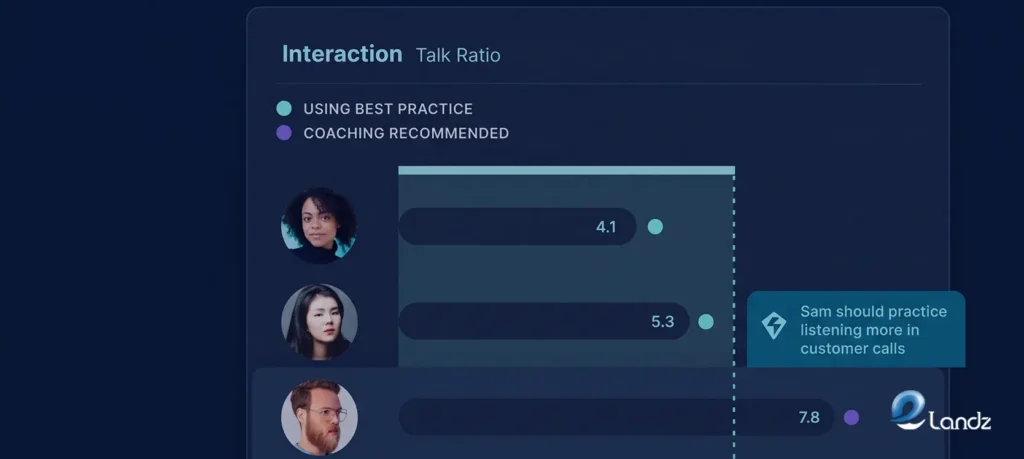
Review call recordings together, identify where deals are dying, and look at what your most efficient closers do differently in the opening minutes of a discovery call. When managers actively coach reps on qualification and deal progression, reps stop wasting time on opportunities that were never going to close.
Improve Your Sales Messaging

Even a well-qualified prospect will go cold if your pitch doesn’t land. Effective sales messaging connects the features of your product to the specific pain the buyer is experiencing. Generic pitches generate generic responses, which means more follow-ups, longer cycles, and lower close rates.
Equip your reps with customizable templates and clear value propositions for different buyer personas, and give them access to relevant case studies and success stories. The goal is to make personalization fast, not time-consuming.
Track the Right Metrics Alongside Efficiency
What is sales efficiency on its own? It’s just one number. To act on it meaningfully, you need to pair it with supporting metrics.
Conversion rate shows you where leads are dropping out of your funnel. Sales cycle length tells you how long an average deal takes to close. Lead response time matters because the faster you respond to a new lead, the higher your conversion odds. The ratio of customer lifetime value to acquisition cost tells you whether the revenue you earn from a customer justifies what it cost to win them. Together, these metrics tell a complete story that sales efficiency alone cannot.
The Role of AI in Driving Efficiency

AI is no longer a future conversation for sales teams. According to HubSpot’s State of AI in Sales report, AI adoption among sales reps nearly doubled in a single year, and reps using AI daily are twice as likely to exceed their targets.
The biggest gains come from automation. Drafting follow-up emails, summarizing call notes, scoring leads, and flagging at-risk deals used to eat hours of selling time. With AI handling that routine work, reps reclaim time for the conversations that actually move deals forward.
Curious how fast your own company answers a new lead? Request a free lead flow audit and get a 10 to 15 minute video showing where leads wait, leak, or go cold. No call needed.
Conclusion
What is sales efficiency, at its core? It’s a signal. When it’s strong, your team is converting resources into revenue without waste. When it weakens, something in your process, your targeting, or your tools is creating drag. Tracking it regularly and pairing it with the right supporting metrics gives sales leaders the clarity to fix problems before they become patterns.
The best sales teams don’t just work harder. They work with less friction, better tools, and clearer direction. That’s what efficiency actually looks like in practice.
Frequently Asked Questions
Sales teams that start measuring efficiency tend to ask similar questions. Here are straightforward answers to the ones that come up most often.
It’s a ratio that shows how much revenue your team generates for every dollar spent on sales. The higher the ratio, the more effectively your team is converting investment into revenue.
Most teams find that quarterly calculations give enough data to spot meaningful trends without overreacting to short-term noise. Teams with faster sales cycles may find monthly tracking more useful.
Gross sales efficiency counts only new revenue generated, which shows how well your sales motion is working in isolation. Net sales efficiency subtracts churned revenue, giving you a more honest view of actual growth.
Start by identifying where time and money are going and where deals most commonly stall. Tightening your lead qualification process and reducing admin work through automation tend to produce the quickest gains.
No, effectiveness measures whether reps are hitting outcomes like quota attainment and win rates. Efficiency measures how well they use their resources to achieve those outcomes, and the strongest teams work to improve both.
Get updates in your inbox
Subscribe to our emails to receive newsletters, product updates, and marketing communications.